
TRUSTING YOUR LOOPS & KNOTS
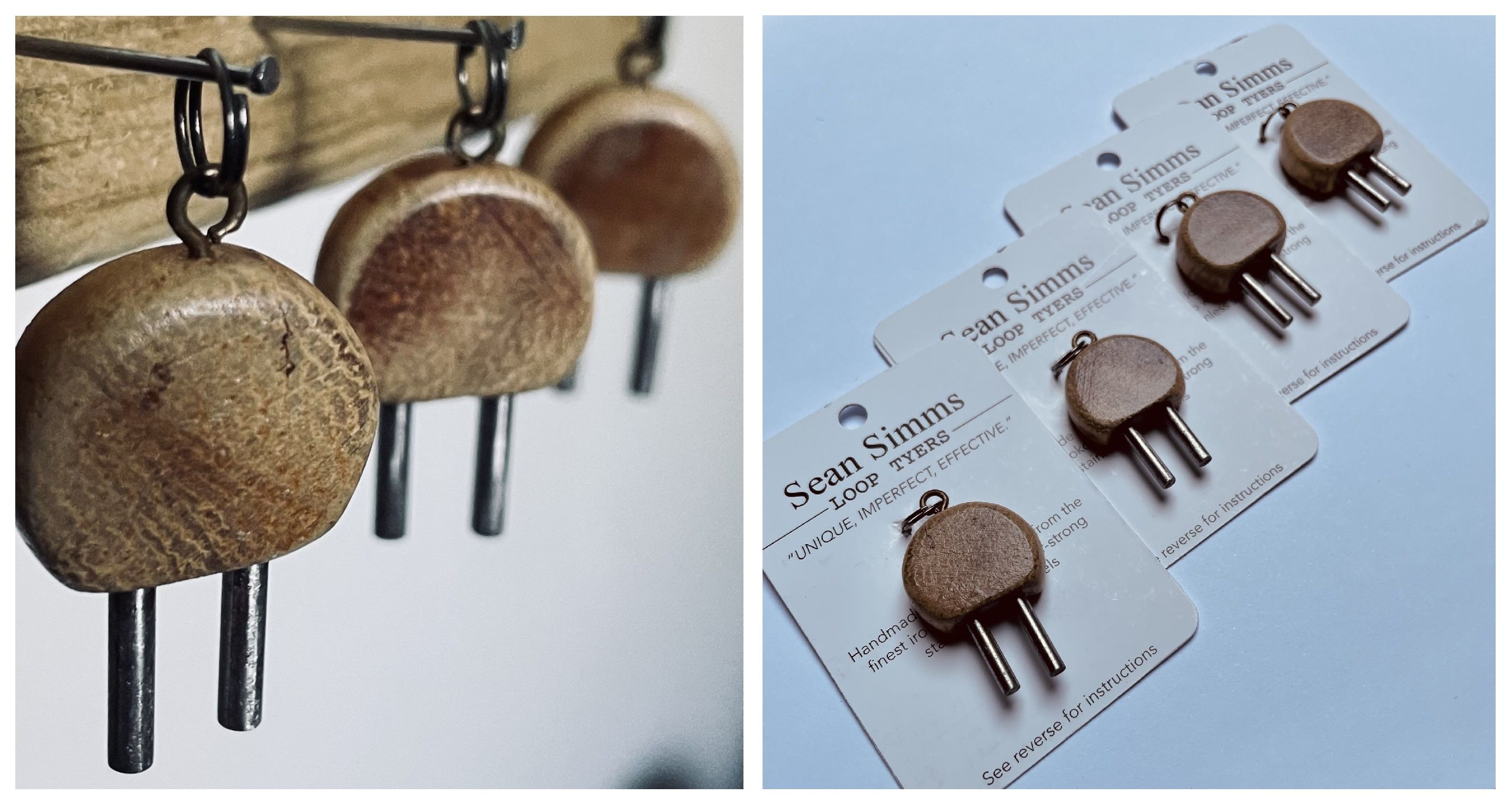
The humble loop tyer is a very basic bit of kit – to put it simply – it ties loops! While this is of course true, the loop tyer actually offers so much more than this. Imagine yourself latched into a huge fish… now throw in the heavy flow of a bulging river, plus rakes of weed straddling your mainline. When your gear is under this kind of additional pressure, it is essential you have 100% trust in your loops and knots. A failure there is not an acceptable way to lose a fish, and you will never forgive yourself if that is what ultimately lets you down. Tying a neat and trusted loop can give you additional confidence, so when you do have to pull that bit harder, you can rest assured that loop and knot won't let you down. While there are many loop typers on the market, the vast majority are made of plastic, and more often than not in some hideous fluorescent shade. If this is not your cup of tea, there is an alternative… Made from beautifully sanded and varnished iroko wood, complete with

MEGA MINNOW
A fun part of fishing involves beating records – be that national, regional, by venue, or personal. That feeling of suspense and excitment as you watch the needle on your weigh scales creeping round to new highs is utterly indescribable. With the larger species like carp and pike often taking the limelight due to their gargantuan record sizes captured in jaw-dropping pictures, you can easily forget that some of our mini species have records too. Truth be told, most of the larger versions of our smaller fish are likely a bycatch when chasing other species, however, a specimen is a specimen! The humble (and much-loved) minnow has seen its record stand for many years now at a whopping 13.5 drams (which equates to around 0.85 of an ounce, or 24 grams). Over the years, many anglers have claimed bigger catches, however, the kind of scales needed to accurately measure something so small are not readily carried by your average fisherman. As for my own story, some years back I was long-trotting

FOND FISHING LICENCE FAREWELL
With my fishing licence renewal fast approaching, it’s a great shame that this year we will not be receiving the stunning artwork that David Miller has gifted us for over 15 years. It was always so exciting to guess what species would feature next, and for many anglers, all those cards either lived in your wallet or purse for the duration, or were stashed away in your bits and bobs drawer while you slowly expanded your sensational set of species. Of course, we can understand the logic behind not providing a hard copy licence when we need to do everything to protect our environment, but that doesn’t dispel any of the disappointment around the end of something incredibly popular which has been loved by so many anglers. With the bronze bream an absolute favourite fish of mine, bringing warm memories of stunning slabs caught from the Shannon on many visits to the Emerald Isle, the 2019-20 Environment Agency UK Rod Licence had particularly strong sentimental value for me. As luck would have

TENCH TIME!
This weekend, I dusted the carp rods off and headed to my local syndicate. I always have a terrible time deciding how to fish there, as along with carp over the magic 30lb mark, the water holds a great head of bream that average 5lb, huge swathes of quality roach, and some cracking tench fishing complete with all the thrills of fizzing bubbles and terrifying proximity to lily pads. It was a bivvy day though, and by 11am both rods were cast over to a submerged treeline which had been kind to me over the years. A good dose of boilies had been peppered around the hook baits (with the help of my throwing stick), and the traps were set for something special. Just 45 minutes into the session, it hadn’t quite gone how I’d planned it… with three bream to 5lb landed, it seemed as though it was likely going to be a busy (but carp-less) day. The runs (or single beeps from the bream) were consistent, and while playing an old snotty on a carp rod isn’t anywhere near as nice as playing one on a medi

BOOK OBSESSION!
How to Catch Them series: Occasionally, we all happen upon things that really resonate with us, and when we feel a connection to something we inevitably want more... Having picked up a copy of Perch – How to Catch Them at a market stall for £2 a few years back, my obsession began. With a book dedicated to every species and tactic, this series of pocket-sized hardbacks were originally published back in the 1950s, however the knowledge within can be just as effective today as it was all those years ago. My collection of these little gems has grown over the years and If I know what species I'm targeting on my next session, I often slip the related book into my fishing bag as a reference point. It's great to be out there, sat on the bank absorbing knowledge from a past era that can really give you the edge when in persuit of your quarry. One of my favourite extracts from the Perch book sends us back even further in time – taken from an 1863 title – which details the placing of a few live m

FLOATING PERFECTION!
Float making, in my opinion, is one of the finest arts in coarse fishing tackle creation. From the users perspective, there is nothing quite like using a handmade float that is delicate enough to show bites from the smallest of fish, but so hard wearing that it can withstand treacherous flows, being hurled through the air on the cast, and of course, take the battering of a heavy battle betwixt human and fish. My absolute favourite float maker is Ian Lewis. His floats are second to none, both for looks, affordability, and functionality. I find myself on his website frequently, and like a child in a sweet store, everything just looks so tempting. Having been lucky enough to acquire a few sets of these floats over the years, I enjoy these both on the bank and displayed in my home office. Below, I've shared a couple of pictures of some of these beauties, and an image of a greedy trout that was my very first capture on a grayling float (which I am still yet to catch a grayling on)!


